
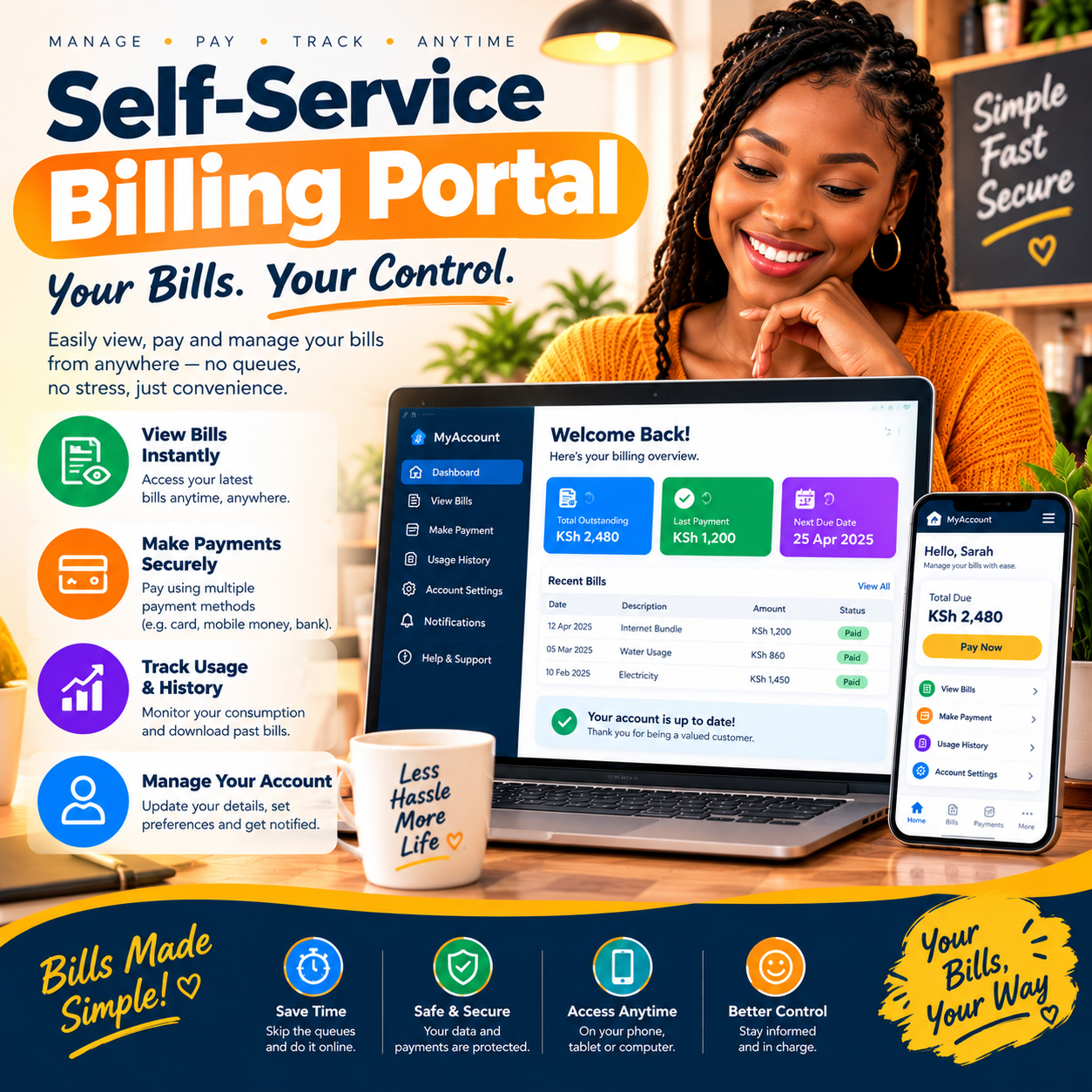
Self-service billing portal technology has quietly become the dividing line between businesses that spend their days chasing payments and businesses that watch payments arrive on their own.
Consider the daily reality of the typical small operator — the neighborhood internet provider, the estate manager, the academy administrator, the gym owner. Mornings begin with a list of who owes what.
The day disappears into reminder messages, polite follow-ups, cash handoffs at the gate, handwritten receipts, and the slow, awkward negotiation with customers who promise to pay “by Friday” every single week.
Evenings end with a ledger that never quite balances and a quiet worry about who was missed. Multiply that routine across a hundred customers and thirty days, and the arithmetic becomes sobering: hours of labor spent collecting money that a machine could collect alone, revenue leaking through forgetfulness and friction, and a business whose growth is capped not by demand but by the owner’s ability to knock on doors.
The operators who discovered self-service billing portal systems broke that ceiling — and the story of how they did it, told here month by month and decision by decision, is one of the most practical business lessons circulating in entrepreneurial circles today.
Because the change a self-service billing portal brings was never really about technology. It was about a business finally being structured so that customers can serve themselves — and pay — without anyone standing in the middle.
The Old Routine: When Every Shilling Had to Be Hand-Delivered
To appreciate what changed, it helps to sit honestly with how billing worked before. Under the manual model, money moved only when a human moved it.
Customers paid cash at a counter, at a gate, at a technician’s visit — wherever the business could physically intercept them.
Staff wrote receipts by hand and reconciled them at night. Missed payments triggered a private choreography of reminders: the polite message, the firmer follow-up, the awkward doorstep conversation. Every step depended on someone remembering, someone being available, and someone being willing to have an uncomfortable conversation.
The costs of this arrangement ran deeper than labor. Cash handling created leakage — honest errors, round-number losses, and the occasional disappearance no ledger could explain.
Records lived in notebooks and memory, which meant every dispute became a swearing contest. And the customer experience was, frankly, poor: a client who wanted to upgrade a package or clear a balance at 11 p.m. had no option but to wait for business hours, and many simply forgot by morning.
Operators studying their numbers often discovered that a self-service billing portal could not make their situation worse — because the manual system was already absorbing its costs daily in labor, leakage, and lost sales.
They had not chosen manual billing as a strategy. They had simply never chosen anything.
There was also a growth problem hiding inside the routine. Every new customer added to the roster added collection work in proportion, so success made the business heavier rather than stronger.
Operators who mapped this curve honestly concluded that a self-service billing portal was not a convenience upgrade but a structural necessity — the only way to grow the customer base without growing the workload at the same rate.
The businesses that reached this conclusion first began searching for a self-service billing portal, and what they found surprised them: the machinery that once required enterprise budgets had become affordable, simple, and built for exactly their scale.
What a Self-Service Billing Portal Actually Is
Strip away the jargon and the concept is beautifully simple. A self-service billing portal is a customer-facing system where the people who owe money can view what they owe, choose what they want, pay it, and receive their service — without speaking to the business at any point.
The customer opens a page on their phone, sees the available packages and prices, selects one, completes payment through mobile money, and the service activates instantly.
Balances, receipts, and purchase history sit in the same place, available at midnight or midday. The business, meanwhile, watches everything arrive in a dashboard: who paid, when, how much, and for what.
The word “self-service” carries the revolution. In the old model, every transaction required a staff member’s hands: to quote a price, to receive cash, to write a receipt, to activate a service, to answer “how much do I owe?” Each of those moments cost labor and introduced delay.
Under a self-service billing portal, those moments become the customer’s own taps on a screen. The business stops being a checkpoint between customers and their purchases and becomes the operator of a system that sells continuously — at 2 a.m., on holidays, during the rain, without fatigue.
It is worth pausing on what this means for scale. A business serving fifty customers manually and one serving five thousand through a self-service billing portal can, in many respects, run on the same skeleton: the portal handles the thousandth transaction with the same ease as the first, and no staff member works harder because the roster grew.
That asymmetry — workload fixed while volume grows — is the quiet engine behind every success story in this space, and it explains why operators who adopt once never voluntarily go back.
The Machinery Under the Hood
The technology enabling a modern self-service billing portal matured dramatically over the past decade, shrinking from enterprise installations into systems a non-technical operator can run from a phone. Four components do the heavy lifting.
The first is the storefront: a clean, mobile-friendly page displaying packages, prices, and account status. The second is the payment layer, wired directly into mobile money — in Kenya, an M-Pesa prompt that appears on the customer’s screen the moment they choose a package.
The third is the automation engine, which takes confirmed payments and activates services instantly: connectivity restored, subscription extended, balance cleared.
The fourth is the dashboard, where the business watches revenue, signups, and activity accumulate in real time.
What makes the modern generation remarkable is what it asks of the operator — almost nothing. No servers to maintain, no code to write, no vouchers to print and guard.
A payment at midnight completes itself; a receipt issues itself; a notification reaches the customer without anyone lifting a finger.
Operators running a self-service billing portal describe the experience as hiring an accountant, a cashier, and a night-shift clerk rolled into one — employees who never sleep, never take leave, and never miscount change.
Reliability engineering has matured alongside simplicity. Contemporary systems handle failed transactions gracefully, confirm payments through timestamped records, protect accounts with per-customer credentials, and log every event for auditing.
When a customer asks “did my payment go through?”, the answer lives in the records rather than in an argument.
That single feature — indisputable, timestamped truth for every transaction — quietly eliminates the disputes that consumed hours under manual billing, and it is one of the least advertised but most valuable things a self-service billing portal delivers.
The Breaking Point: When Manual Billing Stops Adding Up
Every adoption story begins the same way: with numbers that stopped making sense. Picture a typical operator — say, a neighborhood internet provider with two hundred customers.
Under manual billing, collections consume real hours every single day: composing reminders, answering “how much again?”, meeting customers to receive cash, updating the book, chasing the persistent late-payers.
Conservatively, that is several hours daily — a part-time job the owner never applied for. Worse, the collection rate hovers stubbornly below full: some customers pay late, some pay partially, some drift away entirely because paying was always mildly inconvenient and nobody wants to chase them.
Then comes the audit moment — the evening the operator actually counts the cost. Hours spent collecting, converted to a wage equivalent. Revenue lost to churn caused by billing friction.
Cash-handling discrepancies that never quite reconcile. Days of growth foregone because onboarding a new customer meant adding another name to the collection route.
Laid side by side, these numbers make the decision almost automatic: there is no configuration of a self-service billing portal that leaves the business worse off, because the status quo is already charging a daily fee in labor and leakage. The operator had not chosen manual billing. Manual billing had simply never been questioned.
What converts suspicion into action is usually one more discovery: the customers were ready long before the business was.
In markets raised on pay-as-you-go airtime and prepaid tokens, customers already buy utilities by tapping their phones.
Presenting them a self-service billing portal where they can pay for service the same way requires no explanation, no training, and no persuasion — the behavior is already installed.
The operator’s real question flips from “will my customers adapt?” to “how much have I spent making them wait for me?” And that question, once asked, answers itself in favor of self-service billing portal adoption almost every time.
The Switch: How the First Week Actually Feels
Preparation takes less time than feared. The operator picks a platform, loads packages and prices, and connects the payment account — an afternoon’s work for most modern systems.
Then comes the step that separates smooth launches from rocky ones: telling customers before the change, not after. A message goes out — simple, honest, and framed as an upgrade: “You can now pay for your service anytime, from your phone, and it activates instantly. Here’s the link.” No jargon, no lecture, just a door opened.
Launch day brings the moment every operator remembers: the first transaction nobody touched. A customer, unprompted, opens the portal at 6:47 a.m., buys their package, pays by M-Pesa, and watches their service restore — while the operator sleeps.
When the dashboard lights up with the record, the psychological shift happens at once. The business just earned money while closed, and no human did anything.
By the end of week one, the pattern is established: a scattering of payments across early mornings, lunch breaks, and late nights — hours when the business was previously closed for money.
Operators watching a self-service billing portal dashboard for the first time consistently report the same quiet astonishment at how much business used to happen outside business hours — and was simply never captured.
Not everything is frictionless. A few customers ask questions; a few need help finding the link; one or two attempt to pay the old way out of habit.
The operator who answers patiently, and keeps the old door open briefly during the transition, loses no one. By the second week, most customers have paid themselves at least once, and the phrase operators use to describe it is always the same: the customers took to the self-service billing portal faster than the staff did.
The system’s first week ends with a small but profound realization logged in the dashboard — revenue arrived on days and at hours the business had never earned before, all through self-service billing portal automation that asked nothing of anyone.
How Customer Behavior Changes When Payment Becomes Their Choice
The deepest effects of a self-service billing portal show up in customer behavior, and they surprise operators in both direction and speed.
The first change is timing. Payment stops being a scheduled encounter and becomes a spontaneous act: on payday, on Sunday night, at the bus stop, at midnight. The business’s collection window expands from “when we’re open and someone’s around” to “always” — and revenue follows the expanded window immediately.
The second change is psychological, and it resolves a tension the manual model created for years. Under hand-collection, every payment reminder carried a faint flavor of confrontation — the customer owed someone, and someone was asking.
Under a portal, the customer owes a system, and systems ask gracefully: a balance shown on screen, a gentle notification, a package waiting to be tapped.
Operators consistently report that late payments shrink not because customers are chased harder, but because paying became easier than not paying.
The friction that created arrears — the need to find cash, find the owner, find time — simply evaporates, and with it, much of the arrears themselves.
The third change is empowerment, and it builds loyalty in a way discounts never could. Customers who can upgrade a package, check their history, and renew service without asking permission feel ownership of the relationship.
They experiment with bigger packages because trying is easy. They renew earlier because checking is easy. They recommend the service because “I just pay on my phone and it works” is the easiest recommendation in commerce to make.
Across deployments, the pattern repeats: businesses running a self-service billing portal watch their payment-on-time rates climb, their support messages shrink, and their upgrade revenue grow — all from a single design decision that handed customers the keys.
What the manual model treated as a favor the customer did the business — paying — becomes, under a self-service billing portal, a convenience the business does the customer. That reframing alone changes everything about how the relationship feels from both sides.
The First Month in Numbers
Stories persuade, but numbers convince, so the operator tracked everything through the first month. The headline was collection rate: the share of bills actually paid, on time, without a human reminder.
Under manual billing the figure had drifted in the mediocrities — enough to survive, never enough to plan around.
Within the first month of the portal, it climbed visibly, and the reasons were visible in the logs: customers paying the moment they were paid, at hours the business had never collected, through taps that took under a minute.
The second number was labor. Hours previously spent on reminders, receipts, and reconciliation collapsed toward zero.
No codes to write, no books to balance by hand — every transaction arrived timestamped and categorized, and month-end reconciliation, once an evening of squinting at notebooks, became a glance at a report.
The operator converted the recovered hours into the work that actually grows a business: checking equipment, serving customers, signing up new ones.
That trade — administrative hours swapped for growth hours — is the silent return on investment behind every self-service billing portal, and it compounds every month the system runs.
The third number was the one nobody projected: new revenue. Freed from the friction of arranging payment, customers upgraded packages more readily, bought add-ons they would never have requested in person, and referred friends who could now sign themselves up without an appointment.
The dashboard showed revenue arriving in patterns the notebook era had rendered invisible — the lunchtime surge, the end-of-month spike, the midnight renewals.
When the operator laid the three numbers side by side at month’s end — collection rate up, labor down, new revenue streams open — the combined effect exceeded every projection made before the switch.
The leap that had felt risky for months had, measured honestly, paid for itself inside thirty days, and the self-service billing portal had done the heaviest lifting without a single day of hand-holding.
The numbers also settled the staff question permanently: nobody lost a job to the self-service billing portal; the team simply stopped doing arithmetic and started doing growth.
The Surprises Nobody Warns You About
If the financial results were expected, the side effects caught operators completely off guard. The first surprise was data.
For years, the business had been a black box: money in, services out, nothing in between. The portal changed that overnight. Sign-up patterns showed which days brought new customers. Payment timing showed exactly when salaries landed in the neighborhood.
Package choices revealed which offers customers actually wanted — knowledge that immediately reshaped pricing and promotions.
Operators running a self-service billing portal describe the feeling precisely: it is like turning on the lights in a shop you have been managing in the dark. Decisions that were guesses become readings.
The second surprise was the portal as a sales floor. That page customers open to pay is also the page where they browse — which makes it the highest-attention advertising space the business owns.
A new premium package, launched with a banner on the portal, sells itself to exactly the audience already motivated to buy. A seasonal promotion announced there reaches every paying customer without a single flyer.
Operators discover that a self-service billing portal is not just a cashier but a shop window, and the window faces the entire customer base every single day.
The third surprise was reputational. In any market, the business that lets customers serve themselves instantly — at midnight, without a phone call, without a favor — acquires a reputation for professionalism that marketing alone cannot buy.
“I just pay on my phone and it works” becomes the sentence customers use to describe the business to their friends, and every repetition is a referral.
Competitors still collecting cash at the door feel the difference within a quarter. Word moves, and it moves in favor of the operator whose self-service billing portal made their business the easiest to pay in the neighborhood — a title, as every operator eventually learns, that is worth more than any discount ever printed.
The Two Mistakes Operators Make — and How to Fix Them
Honesty demands the record show that launches are not always flawless, and two mistakes recur often enough to deserve their own warning labels.
The first is launching silently. An operator switches the portal on without telling customers, assumes they will find it, and then reads the quiet weeks as rejection — when the actual problem was that nobody knew the door had moved.
The fix costs one afternoon: a clear announcement through every channel the business already uses, an explanation of what customers gain, and a staff briefing so the counter can walk the first hesitant users through their first tap. Operators who communicate before switching report smooth adoption within days; operators who surprise their customers spend a month repairing confusion that a single honest message would have prevented.
The lesson generalizes: a self-service billing portal changes a habit, and habits respond to invitation, not to ambush.
The second mistake is setting the portal up once and never reading it again. The dashboard is not a formality; it is the business’s new nerve center, and it repays attention immediately.
Packages that outsell expectations reveal underpricing. Hours that spike reveal when promotions should fire. Customers who lapse reveal exactly when a nudge would have saved them.
Operators who glance at their self-service billing portal reports weekly — even briefly — tune their way to materially better results within a quarter, while those who never look leave the system running at half its potential.
Pricing under the new model is a living variable, not a one-time decision; the flexibility that modern self-service billing portal platforms provide means no setting is permanent, and refusing to adjust is the only genuinely expensive choice available.
Neither mistake is fatal, and both are cheap to correct the moment they are named. The operators who thrive summarize it the same way: the system was never the hard part — the habits around it were, and both habits are learnable in an afternoon.
Beyond Internet: Where Else the Model Quietly Wins
The neighborhood internet operator may be the most visible adopter, but the migration toward portal billing is far broader, and watching where it spreads reveals how universal the underlying logic really is. Residential estates were early converts.
Property managers who once collected service charges door-to-door — cash envelopes, handwritten receipts, end-of-month mysteries — moved their rents, water, garbage, and maintenance fees onto a portal, and the estate’s finances became readable overnight: who paid, who owes, what collected, all on one screen.
Estates running a self-service billing portal report the same transformation operators describe: arrears shrink, disputes end, and the manager stops being a debt collector and becomes an administrator again.
Schools followed. Fee collection, the chronically painful heartbeat of every private academy, moved from queues at the bursar’s window to taps on parents’ phones — with receipts issuing automatically and balances visible before anyone asks.
Churches adopted portals for tithes, pledges, and event payments, discovering that congregations give more consistently when giving requires no envelope and no Sunday timing.
Gyms, salons, water vendors, waste collectors, parking operators — every business whose revenue is recurring and whose customers carry phones is a candidate, and the pattern repeats identically across them all: collections rise, labor falls, records become trustworthy, and the owner gets their evenings back.
The instructive case is not any single industry but the shared discovery underneath them all: customers in this market already pay for everything by phone — airtime, tokens, deliveries, rides.
Moving billing onto the same behavior is not innovation requiring persuasion; it is alignment with how life already works. That is why adoption accelerates business by business, each success becoming the reference that convinces the next skeptic.
And it is why the question facing most operators is no longer whether a self-service billing portal fits their industry, but how long their industry will remain the last one still collecting cash at the door while every self-service billing portal success story next door compounds quietly.
Trust, Security, and the End of Cash on the Table
Whenever money moves digitally, trust deserves a serious conversation — and modern portal systems earn it through architecture rather than promises.
Start with payments. Customers pay through their own mobile money prompt, entering their PIN only on their own phone, inside the payment provider’s trusted environment.
The business never touches the PIN, never handles the cash, and never stands at a counter with money passing over wood — which eliminates, in one design decision, the entire category of losses that cash handling invited: miscounts, shortages, temptations, and the disputes that follow them.
Records complete the trust structure. Every transaction through a self-service billing portal generates a timestamped, numbered receipt that both parties keep automatically.
When a customer asks “did my payment go through?”, the answer is not an opinion but a record — findable in seconds, shown to anyone, arguable by no one.
Under manual billing, disputes were resolved by memory and volume of voice; under the portal, they are resolved by scrolling. Operators consistently name this as the single most underrated benefit of the switch: not the hours saved, but the arguments that simply stopped happening.
Data protection rounds out the picture. Reputable platforms collect only what they need — a name, a phone number, a payment confirmation — protect it with the same infrastructure that guards the payments themselves, and put consent in writing where it belongs.
Customers, for their part, demonstrably trust the arrangement: the same person hesitant to hand cash to a courier thinks nothing of tapping a payment to a system that receipts instantly.
That trust is not an accident; it is the accumulated credibility of millions of mobile money transactions, and a self-service billing portal plugs directly into it.
The business inherits the safest payment rails in the market the moment it switches — and every payment processed through self-service billing portal infrastructure strengthens a chain of trust that cash never built and never could.
Six Months In: The Business That Runs Its Own Rhythm
Six months after the switch, the transformation is visible from outside. The operator’s day looks nothing like it used to: no morning reminder list, no lunchtime cash handoffs, no evening reconciliation ritual.
Collections happen continuously in the background — a payment here, a renewal there, each confirming itself with a notification the owner reads between real work.
Month-end, once the most stressful week of the calendar, is now a report: revenue summarized, arrears listed, trends charted, all generated without anyone assembling anything.
The customer-facing rhythm changed just as visibly. New customers sign up themselves, at all hours, without waiting for an appointment — and the business grows in its sleep in the most literal sense.
Package upgrades arrive through taps rather than negotiations. Renewals happen on time because reminders issue automatically and paying takes seconds.
The support burden, once dominated by “how much do I owe?” and “did you get my payment?”, thins to genuinely unusual cases — and each of those resolves quickly because the records answer every factual question in advance.
Financially, six months of self-service billing portal operation compounds into something the manual years never produced: predictability.
Revenue arrives in known patterns, at known hours, at known rates — which makes planning possible in a way hand-collection never allowed.
The operator who once could not say what Friday’s collections would look like now forecasts the month within a narrow band, budgets against it, and invests against it.
That predictability, operators agree, is the quiet superpower the portal grants: not just more money, but money whose behavior is understood. And the deepest change is strategic rather than financial: the business finally has a growth path that does not run through the owner’s own hours.
Every additional customer the self-service billing portal onboards adds revenue without adding collection labor — which means, for the first time in the business’s life, scale is a door that is actually open.
Owners who reach this point describe the self-service billing portal less as software and more as a promotion: the day the business stopped needing them for its own survival.
The Support Question: What Happens When Something Goes Wrong
No honest examination skips the failure cases, because every operator eventually meets one: a payment that confirmed but did not activate, a customer who paid the wrong account, a session that expired mid-use.
The first thing to know is how rare these are — the overwhelming majority of transactions complete cleanly and never require a human — and the second thing is how well the systems handle the exceptions when they come.
Every exception arrives with its paper trail attached. A payment that did not activate can be traced in seconds through its confirmation code, because the timestamped record shows exactly what the customer paid and when.
A payment to the wrong account can be identified and redirected before the mistaken service is consumed, provided the customer reports promptly. An expired session shows its own history — when it started, when it ended, what was purchased — which converts a complaint into a shared reading of facts.
Operators running a self-service billing portal report that the questions which once consumed half an hour of arguing now consume two minutes of scrolling, and that alone transforms the emotional temperature of customer service.
The second line of defense is design: modern portals prevent most failures before they occur. Payments confirm before services activate, so no one is left in limbo. Failed transactions return cleanly with clear messages rather than silent losses.
Notifications reach customers at the moments that matter — on payment, on expiry, on low balance — so surprises become rare by construction.
And when a genuinely stuck case needs escalation, the platform’s support team can see the same records the operator sees, which means everyone argues with the data rather than with each other.
The overall message is the one experienced operators give newcomers: the self-service billing portal did not create new problems; it made the old ones rare, visible, and quickly resolvable — and the business that once feared its own billing now reads it the way a self-service billing portal dashboard should be read: calmly, briefly, and with full information.
The Lessons Worth Borrowing
Strip the adoption stories to their transferable lessons and five principles survive, each earned in real-world installments.
First, audit before you act.The operators who switched successfully began by counting what manual billing actually cost — hours, leakage, churn, arrears — and the arithmetic made the decision for them.
The ones who hesitated were not choosing the old system; they were choosing not to count, which is the same arrangement many businesses maintain with their self-service billing portal decision today: unexamined, and therefore expensive.
Second, communicate before you switch. Every smooth launch was preceded by an honest announcement framed as what it truly was — an upgrade for the customer, not a convenience for the owner.
Third, read the dashboard weekly. The system’s reports are the business’s new eyes, and the operators who look, learn, and adjust consistently outperform those who set the portal up once and never glance back.
The flexibility built into a modern self-service billing portal — pricing, packages, promotions, all adjustable in minutes — rewards attention the way no fixed system ever could.
Fourth, keep the door open during transition. The customers who needed a hand through their first tap became the system’s most loyal users afterward; patience in week one bought advocacy for years.
Fifth, sell the outcome, not the technology. Every message that worked said the same thing in different words: pay anytime, activate instantly, receipts automatic, no more waiting for anyone.
That framing is not marketing; it is the literal truth of what self-service billing portal systems deliver, and it is the difference between customers adopting a tool and customers tolerating one.
Seasoned operators give every newcomer the same closing summary, and it deserves to be repeated in full: the technology was the easy part, the customers adapted faster than feared, the staff were relieved rather than threatened — and the only genuinely expensive mistake in this entire journey is the years spent not counting what manual billing was quietly costing all along.
Is This the New Normal? The Adoption Wave Compounds
The fair question about any single success story is whether it generalizes, and the evidence of the past few years answers with unusual clarity.
What began as early adopters experimenting has become a visible market norm, one industry at a time: internet operators first, then estates, then schools, then churches, gyms, water vendors, and beyond.
Each public success lowers the psychological barrier for the next operator, and each neighborhood that contains one portal-run business becomes a neighborhood where customers expect the option everywhere.
That is how local edges compound into market standards — quietly, business by business, until the question inverts from “why would I use one?” to “why doesn’t everyone?”
The structural drivers of the wave are not location-dependent. The arithmetic that converts billing labor into billing automation holds anywhere customers carry phones and payments run on mobile money.
The behavioral foundation — a market trained by years of pay-as-you-go utilities to purchase services in tapped, self-serve units — is national, not neighborhood.
The courtesy of instant receipts, the trust of timestamped records, the reach of a storefront that never closes: these are features of the self-service billing portal model itself, and they perform identically in a city center, a market town, or a rural trading center.
What varies is only the speed of uptake, and even there the pattern is consistent: the businesses that adopt first bank the loyalty, the data, and the operating discipline that latecomers must later buy back at a premium.
The competitive window, in other words, is open now and closing at a predictable pace. Every month, self-service payment becomes less of a differentiator and more of a baseline expectation, the way it already is in banking, transport, and communications.
Operators installing a self-service billing portal during this transitional period are accumulating advantages — customer habits, clean records, predictable revenue — that competitors who wait will find genuinely difficult to purchase later.
Trends this structural do not reverse; they only reward the early. And the customers, whose taps started it all, have already voted: they pay where paying is easy, and the businesses that made it easy — the ones running a self-service billing portal — are the ones their money finds first, every month, without anyone asking twice.
Frequently Asked Questions
Do customers actually use the portal, or do they still call the business?
They use it — overwhelmingly, and faster than operators expect. The behavior is already familiar from airtime, tokens, and everyday mobile money, so the learning curve is measured in minutes.
Across deployments, the majority of transactions shift to the self-service billing portal within the first weeks, and calls collapse to genuinely unusual cases.
What happens if a payment is made but the service doesn’t activate?
Every payment carries a confirmation code and timestamp, so the case is traceable in seconds rather than debated in theory.
The records on self-service billing portal systems show exactly what was paid and when, and activation follows confirmation — which makes the rare failure quick to identify and quick to fix.
Can the business still take cash or offer special discounts?
Yes, on the operator’s terms. A self-service billing portal typically supports manual or counter payments alongside digital ones, and discounts, promo codes, and complimentary packages can be issued through the same dashboard — so flexibility survives automation.
How difficult is setup for a non-technical operator?
Far easier than expected: packages and prices are entered through a web interface, the payment account connects once, and the system runs from there.
Operators of self-service billing portal platforms routinely complete setup in an afternoon, with no server, no code, and no technical staff required at any point.
What stops one account from being shared or misused?
Accounts are protected with per-customer credentials, and service activation binds to the paying account, so one purchase serves one customer.
Self-service billing portal systems log every access and transaction, which makes misuse visible and traceable rather than invisible as it was under cash.
Does the model work for businesses beyond internet providers?
It works wherever revenue is recurring and customers carry phones: estates, schools, churches, gyms, water vendors, waste collectors, and more.
The pattern repeats across industries — collections rise, labor falls, records become trustworthy — which is why the self-service billing portal model keeps spreading one industry at a time.
How are refunds and disputes handled?
Through records rather than arguments: every transaction is timestamped, numbered, and receipted automatically on both sides.
When a dispute arises under a self-service billing portal, both parties read the same factual history, which resolves most questions before they become conflicts.
What about customers without smartphones?
Most portal pages work on basic browsers, and payments can complete through the customer’s own handset or with help at the counter — the operator can always issue a payment on the customer’s behalf through the same self-service billing portal dashboard, so no one is excluded during the transition.
How does switching affect cash flow?
Positively and quickly: payments arrive continuously instead of in collection-day batches, arrears shrink as paying becomes easier than delaying, and revenue becomes predictable enough to plan against.
Operators tracking their first quarter on self-service billing portal reports consistently report tighter, smoother, earlier cash flow.
Can the portal connect to systems the business already uses?
Modern platforms are built for integration — exports, APIs, and connections to accounting, messaging, and service-management tools are standard.
A self-service billing portal typically slots into existing operations rather than replacing them, with the dashboard becoming the center the other tools report to.
What does it cost compared to what it saves?
The honest comparison is portal fees against the full manual bill: collection labor, leakage, arrears, churn, and reconciliation hours.
Measured that way, operators almost universally find the self-service billing portal pays for itself within the first months — often within weeks once recovered hours are priced honestly.
What is the first step for a skeptical operator?
Count what manual billing costs today — hours, leakage, arrears, and churn — and then watch one live demonstration of a self-service billing portal completing a real transaction from payment to activation.
Every operator walked through those two steps reaches the same conclusion: the model was never the risk; the unexamined status quo was