
Table of Contents
ToggleWiFi Hotspot Business
A WiFi hotspot business has become one of the most attractive technology ventures in Kenya. As internet usage continues to grow, many people are looking for affordable and reliable alternatives to expensive mobile data bundles. This creates opportunities for entrepreneurs who want to sell internet access in apartments, hostels, shopping centres, markets, schools, churches, hotels, cafés, and rural trading centres.
Unlike many online guides that promise unrealistic profits, a successful WiFi hotspot business depends on choosing the right location, investing in reliable equipment, automating billing, maintaining excellent customer service, and continuously improving network performance. Recent Kenyan guides increasingly emphasize sustainable operations, realistic revenue expectations, and billing automation rather than exaggerated income claims.
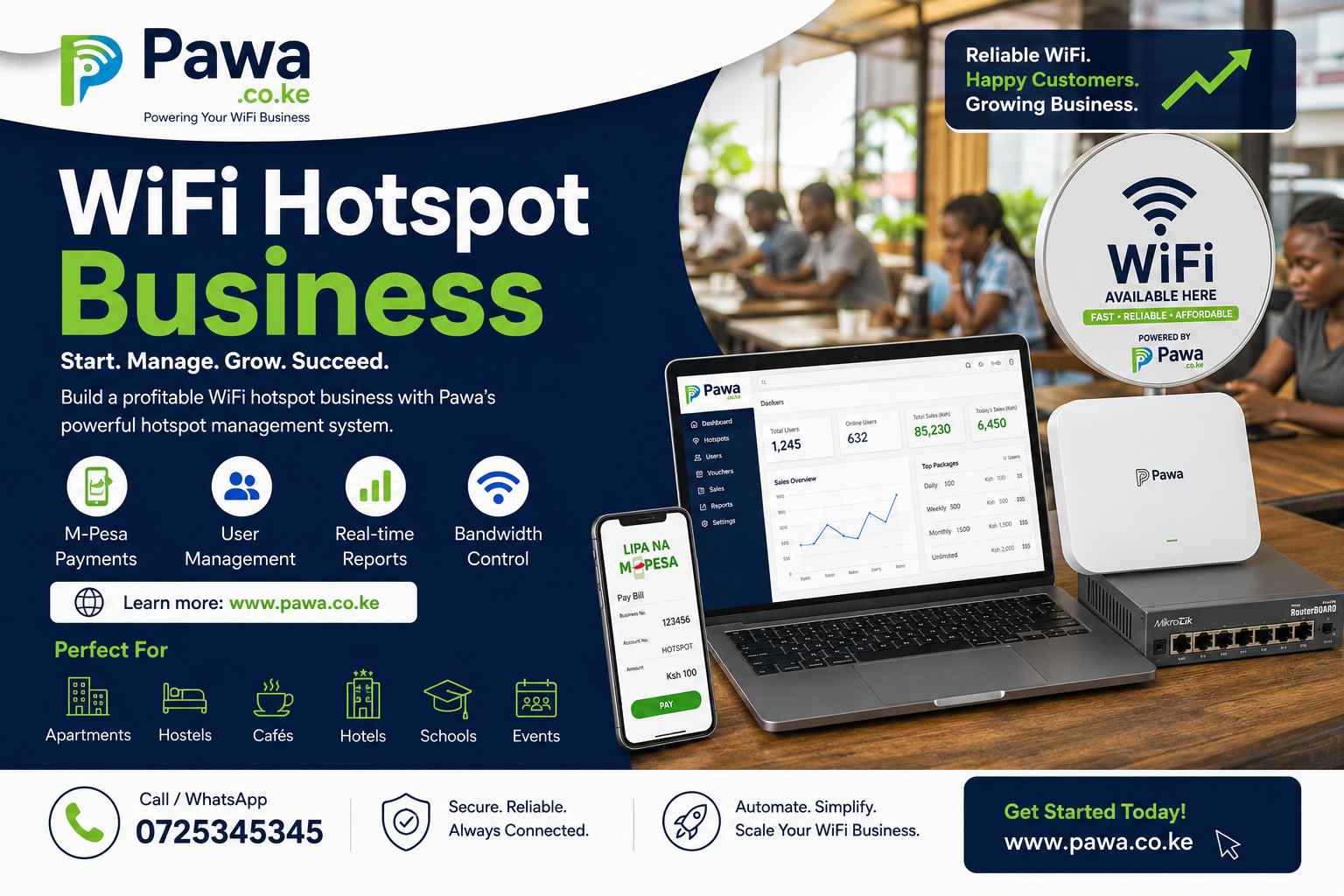
With modern hotspot management platforms like Pawa, entrepreneurs can automate user authentication, voucher sales, M-Pesa payments, bandwidth management, customer accounts, and reporting from one centralized dashboard.
This comprehensive guide explains everything you need to know about building a profitable WiFi hotspot business in Kenya.
Why the WiFi Hotspot Business Is Growing in Kenya
Kenya’s digital economy continues to expand rapidly. More people rely on the internet for:
- Remote work
- Online learning
- Video streaming
- Social media
- Digital banking
- M-Pesa transactions
- E-commerce
- Government services
- Business communication
- Artificial intelligence tools
Although mobile internet is widely available, purchasing daily bundles can become expensive for heavy users. Many customers prefer paying a small amount for unlimited WiFi access over a fixed period.
This growing demand has created opportunities for entrepreneurs to establish hotspot businesses in locations with high customer density. Strategic placement, reliable connectivity, and automated billing are repeatedly identified as key success factors.
Related Resources: WiFi Hotspot System • Hotspot Business Requirements
What Is a WiFi Hotspot Business?
A WiFi hotspot business provides paid internet access to customers using wireless networking equipment connected to an internet service provider.
Instead of selling physical products, hotspot operators sell internet access packages.
Customers typically purchase:
- Hourly packages
- Daily packages
- Weekly subscriptions
- Monthly subscriptions
- Unlimited plans
- Voucher-based access
Modern hotspot businesses automate these services using hotspot billing software instead of manually issuing passwords.
Businesses That Can Start a WiFi Hotspot Business
Many organizations can generate additional income through commercial WiFi services.
Examples include:
- Apartment buildings
- Student hostels
- Universities
- Colleges
- Hotels
- Guest houses
- Restaurants
- Cafés
- Shopping centres
- Markets
- Churches
- Bus stations
- Hospitals
- Salons
- Gaming lounges
- Co-working spaces
Any location with regular foot traffic and internet demand can become a profitable hotspot location.
Related Resource: Hotspot Business Kenya
Equipment Required
Every professional WiFi hotspot business requires reliable networking infrastructure.
Typical equipment includes:
- Fibre or fixed wireless internet connection
- MikroTik router
- Enterprise WiFi access points
- Network switches
- Ethernet cabling
- UPS or backup power
- Outdoor enclosures (if necessary)
- Surge protection
- Hotspot billing software
Choosing quality equipment reduces downtime while improving customer satisfaction.
Choosing the Right Location
Location determines the success of your hotspot business more than almost any other factor.
Good locations usually have:
- High pedestrian traffic
- Limited affordable internet options
- Students
- Rental apartments
- Businesses
- Tourist activity
- Strong purchasing power
Examples include:
- University hostels
- Apartment estates
- Market centres
- Bus stages
- Shopping malls
- Beaches
- Parks
- Event venues
Even the best networking equipment cannot compensate for poor customer demand.
Internet Connection Requirements
Reliable internet forms the backbone of every wifi hotspot business.
When selecting an ISP, consider:
- Bandwidth
- Uptime
- Service Level Agreements
- Customer support
- Static IP availability
- Business internet packages
- Scalability
Poor internet quality results in dissatisfied customers regardless of pricing.
Why Billing Automation Matters
Many first-time operators initially manage users manually.
As customer numbers increase, manual management quickly becomes difficult.
Automated hotspot billing software enables businesses to:
- Sell vouchers
- Process M-Pesa payments
- Create customer accounts
- Suspend expired users
- Monitor bandwidth
- Generate reports
- Manage multiple hotspots
- View sales dashboards
Automation reduces errors while improving customer experience.
Pawa offers centralized hotspot billing, payment integration, user management, and remote administration for Kenyan hotspot operators.
Related Resource: WiFi Hotspot System
Pricing Your WiFi Hotspot Business
Pricing depends on:
- Location
- Customer income
- Competition
- Internet speed
- Operating costs
Common package structures include:
- 1 Hour
- 3 Hours
- Daily
- Weekend
- Weekly
- Monthly
Instead of competing solely on price, successful businesses focus on speed, reliability, and customer support.
Marketing Your WiFi Hotspot Business
Even the fastest WiFi network requires effective marketing.
Marketing strategies include:
- Posters
- Road signage
- Social media
- Referral programs
- Free trial vouchers
- Local influencers
- WhatsApp groups
- Community partnerships
Satisfied customers often become your best marketers.
Startup Costs for a WiFi Hotspot Business in Kenya
One of the first questions aspiring hotspot entrepreneurs ask is how much capital is required to get started. The answer depends on the size of the network, the number of expected users, the quality of equipment purchased, and the coverage area.
A small hotspot serving a single apartment block may require only a few access points and one router, while a larger deployment covering a university hostel, shopping centre, or gated estate will need enterprise-grade networking equipment capable of supporting hundreds of simultaneous users.
Typical startup expenses include:
- Internet installation
- Monthly internet subscription
- MikroTik router
- Enterprise WiFi access points
- Network switches
- Ethernet cabling
- Installation labour
- UPS backup system
- Router cabinet
- Lightning protection
- Hotspot billing software
- Marketing materials
Rather than choosing the cheapest equipment available, successful entrepreneurs invest in reliable hardware that reduces downtime and maintenance costs over the long term.
Related Resources: Hardware for WiFi Hotspot Business • MikroTik Hotspot Setup
WiFi Hotspot Business Revenue Streams
Many people assume that hotspot operators only earn income by selling internet bundles. In reality, there are several ways to generate revenue from a hotspot business.
Potential income streams include:
- Daily WiFi packages
- Weekly subscriptions
- Monthly subscriptions
- Voucher sales
- Business internet packages
- Corporate WiFi services
- Guest WiFi for hotels
- Event WiFi services
- Apartment internet services
- Managed hotspot services
- Installation services
- Router configuration services
Diversifying income sources improves long-term business sustainability.
Apartment WiFi Hotspot Business
Apartment complexes are among the best locations for a hotspot business because tenants require reliable internet every day.
Benefits include:
- Recurring monthly customers
- Lower marketing costs
- Predictable revenue
- Reduced travel expenses
- Easy customer support
- Opportunity to upgrade customers
Many landlords also prefer partnering with hotspot providers because internet access increases the attractiveness of their rental properties.
Related Resource: Apartment WiFi Business Guide
Campus and Hostel WiFi Business
University students consume large amounts of internet for:
- Online classes
- Research
- Video streaming
- Gaming
- Social media
- AI tools
- Programming
- Video conferencing
Student hostels often provide one of the highest customer densities available, making them ideal for hotspot businesses.
However, operators should ensure sufficient bandwidth to support many simultaneous users during peak evening hours.
Related Resource: Sell WiFi Around Campuses
Hotel and Guest House WiFi
Hotels increasingly view reliable WiFi as a necessity rather than a luxury.
Guests expect:
- Fast internet
- Secure connections
- Easy login
- Reliable coverage
- Mobile payment options
Hotspot software enables hotel managers to issue guest vouchers while controlling bandwidth and access duration automatically.
Church WiFi Hotspot Business
Churches can also benefit from managed hotspot systems.
Possible applications include:
- Guest internet access
- Conference WiFi
- Youth events
- Training sessions
- Office internet management
Some churches provide free internet during services while charging visitors during weekdays to generate additional operational income.
WiFi for Shopping Centres
Retail environments benefit from managed public WiFi because it:
- Increases customer dwell time.
- Encourages repeat visits.
- Supports digital payments.
- Enables customer engagement.
- Improves shopping experiences.
Shopping centres can also use hotspot login pages to advertise tenant businesses and promotions.
Bandwidth Management
One of the biggest mistakes new hotspot operators make is allowing a few heavy users to consume all available bandwidth.
Bandwidth management enables operators to:
- Allocate fair usage.
- Prevent network congestion.
- Prioritize premium users.
- Improve browsing speeds.
- Reduce customer complaints.
Pawa allows administrators to configure bandwidth profiles that automatically apply to different subscription packages.
Related Resource: WiFi Billing Software Kenya
M-Pesa Integration
Kenyan customers overwhelmingly prefer mobile payments.
A professional hotspot business should allow customers to:
- Pay instantly using M-Pesa.
- Receive automatic login credentials.
- Renew subscriptions automatically.
- View payment confirmations.
- Purchase packages 24/7.
Automated payment processing reduces manual work while improving customer convenience.
Voucher Management
Voucher systems remain popular in:
- Schools
- Hotels
- Cyber cafés
- Events
- Conference centres
- Public hotspots
Administrators can generate thousands of vouchers within seconds and define:
- Validity period
- Download limits
- Upload limits
- Expiry dates
- Bandwidth allocation
This provides flexibility while maintaining full control over network access.
Customer Self-Service
Modern customers expect convenience.
Self-service portals allow customers to:
- Purchase packages online.
- Reset passwords.
- View account status.
- Renew subscriptions.
- Update contact information.
- Check remaining usage.
Reducing manual customer support saves both time and operational costs.
Remote Network Management
Cloud-based hotspot management enables administrators to monitor networks without visiting each location physically.
Managers can remotely:
- View active users.
- Suspend accounts.
- Update pricing.
- Generate reports.
- Restart services.
- Monitor bandwidth.
- Add new packages.
Remote administration becomes especially valuable when operating multiple hotspot locations across different towns.
Analytics and Business Intelligence
Every successful business relies on accurate data.
Hotspot software provides valuable insights such as:
- Daily revenue.
- Monthly revenue.
- Active users.
- Peak usage hours.
- Popular packages.
- Customer retention.
- Payment trends.
- Network utilization.
These reports help business owners make informed expansion decisions.
Marketing Tips for Your WiFi Hotspot Business
Building a hotspot network is only the first step. You also need effective marketing to attract and retain customers.
Successful operators often use:
- Google Business Profile.
- Facebook advertising.
- WhatsApp marketing.
- Referral bonuses.
- Student ambassador programs.
- Local business partnerships.
- Outdoor banners.
- Flyers.
- Community events.
- Customer loyalty rewards.
Providing excellent service remains the most effective marketing strategy because satisfied users frequently recommend reliable internet providers to friends and family.
Customer Experience
Customer retention depends on:
- Fast internet
- Reliable uptime
- Easy login
- Mobile payments
- Friendly support
- Fair pricing
- Good coverage
- Secure connections
Businesses that consistently provide excellent service build loyal customer bases.
Managing Multiple Hotspots
As your business grows, managing multiple locations manually becomes increasingly challenging.
Cloud-based hotspot management enables operators to:
- Monitor all locations
- View sales
- Manage users
- Update pricing
- Configure routers remotely
- Generate reports
- Track performance
Pawa allows operators to manage multiple hotspot locations from a single dashboard, simplifying expansion.
Security Considerations
Public WiFi networks should prioritize security.
Recommended practices include:
- Secure administrator passwords
- Regular firmware updates
- Customer authentication
- Firewalls
- Network segmentation
- Regular backups
- Secure payment processing
Protecting your network also protects your business reputation.
Common Challenges
Every hotspot business faces challenges such as:
- Internet outages
- Power interruptions
- Equipment failures
- Customer support requests
- Network congestion
- Hardware theft
- Competition
- Weather conditions
Planning for these challenges helps maintain consistent service.
Scaling Your Business
Successful operators often expand from one location to several.
Growth strategies include:
- Adding new access points
- Opening new locations
- Introducing premium packages
- Offering business internet
- Selling networking equipment
- Partnering with landlords
- Providing managed WiFi services
Scalable software makes expansion significantly easier.
How to Choose the Best Internet Service Provider for Your WiFi Hotspot Business
Your internet service provider (ISP) will have a direct impact on customer satisfaction. Even if you invest in premium networking equipment, unreliable internet connectivity can lead to slow browsing speeds, buffering, and frequent complaints.
When comparing internet providers, evaluate factors such as:
- Network uptime.
- Download and upload speeds.
- Service Level Agreements (SLAs).
- Technical support availability.
- Installation costs.
- Scalability.
- Static IP availability.
- Business packages.
- Fiber coverage.
- Backup connectivity options.
Many successful hotspot operators also maintain a secondary internet connection that automatically takes over if the primary connection fails, minimizing downtime and protecting revenue.
Related Resource: Best Internet for WiFi Hotspot Business
Understanding Customer Usage Patterns
Knowing how customers use your network helps you create attractive pricing packages and improve user satisfaction.
Different customer groups have different internet needs:
Students
Students commonly use WiFi for:
- Online classes.
- Research.
- AI tools.
- YouTube learning.
- Video conferencing.
- Assignment submissions.
Office Workers
Professionals typically require internet for:
- Email.
- Cloud applications.
- Remote meetings.
- File sharing.
- Online collaboration.
Entertainment Users
Many residential customers primarily use WiFi for:
- Netflix.
- YouTube.
- TikTok.
- Facebook.
- Instagram.
- Gaming.
By understanding your audience, you can design packages that meet their expectations without overloading your network.
Customer Support Matters
Providing fast customer support is one of the easiest ways to differentiate your hotspot business from competitors.
Customers appreciate businesses that respond quickly when they experience:
- Login difficulties.
- Slow internet.
- Payment issues.
- Voucher problems.
- Password resets.
- Coverage concerns.
Offering WhatsApp support, SMS notifications, and clear contact information can significantly improve customer retention.
Importance of Reliable WiFi Coverage
Many hotspot businesses lose customers because of weak wireless coverage rather than slow internet speeds.
Proper network planning should consider:
- Building size.
- Wall materials.
- Number of users.
- Outdoor coverage.
- Signal interference.
- Access point placement.
- Future expansion.
Professional installation ensures consistent coverage throughout the service area.
Expanding Beyond One Location
Many entrepreneurs begin with one hotspot before expanding into multiple neighborhoods or towns.
Expansion opportunities include:
- Apartment estates.
- Student hostels.
- Hotels.
- Restaurants.
- Shopping malls.
- Rural trading centres.
- Bus parks.
- Office buildings.
- Hospitals.
- Event venues.
Cloud-based management platforms like Pawa make it possible to oversee all locations from one dashboard, eliminating the need to manage each site individually.
Franchise Opportunities
As your business grows, you may choose to partner with property owners or entrepreneurs who want to offer internet services under your management.
Possible partnership models include:
- Revenue sharing.
- Equipment leasing.
- Managed hotspot services.
- White-label hotspot management.
- Installation partnerships.
These models allow rapid expansion without purchasing every new location yourself.
Branding Your WiFi Hotspot Business
A recognizable brand builds trust and encourages customer loyalty.
Professional branding includes:
- Business name.
- Logo.
- WiFi login page.
- Voucher design.
- Customer portal.
- Social media presence.
- Professional invoices.
- SMS branding.
Your hotspot login page can also promote new packages, customer offers, or partner businesses.
Common Mistakes New Operators Make
Many first-time hotspot entrepreneurs encounter similar challenges during the early stages of their business.
Some common mistakes include:
- Purchasing low-quality equipment.
- Underestimating bandwidth requirements.
- Choosing poor business locations.
- Ignoring customer support.
- Setting prices too low.
- Failing to automate billing.
- Poor network planning.
- Lack of backup power.
- Inadequate security.
- No marketing strategy.
Avoiding these mistakes can significantly improve long-term profitability.
Future Trends in the WiFi Hotspot Business
Kenya’s internet market continues to evolve, creating new opportunities for hotspot operators.
Emerging trends include:
- Cashless payments.
- AI-powered network monitoring.
- Smart bandwidth allocation.
- Cloud-managed networking.
- Digital customer onboarding.
- Self-service portals.
- Real-time analytics.
- Multi-location hotspot management.
- WiFi marketing platforms.
- Integration with customer loyalty programs.
Businesses that adopt modern technology early are often better positioned to compete in an increasingly digital economy.
Why Automation Is Essential
Manual hotspot management may work when serving only a few customers, but it quickly becomes inefficient as demand grows.
Automation helps businesses:
- Reduce administrative work.
- Eliminate billing errors.
- Improve customer experience.
- Increase operational efficiency.
- Monitor revenue.
- Simplify reporting.
- Enhance network management.
- Scale without increasing staff.
Pawa automates these processes, allowing operators to spend less time on repetitive administrative tasks and more time growing their business.
Why Entrepreneurs Across Kenya Choose Pawa
Pawa has become a trusted hotspot management solution because it combines powerful automation with an easy-to-use interface designed for Kenyan businesses.
With Pawa, hotspot operators can:
- Accept automated M-Pesa payments.
- Create flexible internet packages.
- Generate access vouchers.
- Monitor customer usage.
- Manage bandwidth.
- Track business performance.
- View financial reports.
- Support multiple hotspot locations.
- Manage users remotely.
- Improve customer satisfaction.
Whether you are operating a small apartment hotspot or managing a large multi-site internet business, Pawa provides the tools needed to streamline operations and maximize efficiency.
Managing a WiFi hotspot business requires more than routers and internet connectivity.
Pawa provides an integrated hotspot management platform that helps operators:
- Automate M-Pesa payments
- Manage customer accounts
- Generate vouchers
- Monitor network performance
- Track revenue
- Manage multiple locations
- Control bandwidth
- Produce business reports
Instead of relying on spreadsheets or manual voucher systems, entrepreneurs can manage their entire hotspot operation from one centralized platform.
A WiFi hotspot business offers significant opportunities for entrepreneurs who focus on reliable infrastructure, excellent customer service, and efficient business management. Success depends less on unrealistic profit promises and more on careful planning, strategic location selection, dependable internet service, and automated operations.
Whether you are serving students, apartment residents, shoppers, travelers, or businesses, investing in professional hotspot management software helps simplify operations while improving customer satisfaction.
With Pawa, hotspot operators can automate billing, integrate M-Pesa payments, manage customers remotely, and confidently grow from a single hotspot to a nationwide WiFi business.
Related Resources:
- Best WiFi Billing Software Kenya
- WiFi Hotspot System
- MikroTik Hotspot System
- Hardware for WiFi Hotspot Business
- How to Sell Internet Around Campuses Kenya
- Hotspot Business Requirements
- Apartment WiFi Business
- WiFi Hotspot Business Plan
Frequently Asked Questions
What is a WiFi hotspot business?
A WiFi hotspot business sells internet access to customers through wireless networks using hotspot billing software, routers, and payment systems.
How much capital do I need?
Startup costs vary depending on equipment, internet connection, and location. Your budget should cover networking hardware, installation, internet service, backup power, and hotspot management software.
Can I accept M-Pesa payments?
Yes. Modern hotspot billing platforms such as Pawa support automated M-Pesa payment integration for convenient customer purchases.
Where should I start a wifi hotspot business?
Good locations include apartments, hostels, campuses, shopping centres, markets, restaurants, hotels, churches, and other areas with high demand for affordable internet.
Why use Pawa?
Pawa simplifies hotspot management by automating billing, customer authentication, M-Pesa payments, reporting, bandwidth management, and multi-site administration, allowing you to grow your WiFi hotspot business efficiently.