
Table of Contents
ToggleWifi hotspot for clubs
A wifi hotspot for clubs is a managed wireless internet service designed specifically for entertainment venues, social clubs, sports clubs, lounges, members’ clubs, nightclubs, bars and other establishments where customers spend time and expect convenient internet access. Unlike ordinary household WiFi, a professional club hotspot needs to handle many simultaneous users, control bandwidth, provide secure access, support customer authentication and, where the business wants to monetize connectivity, allow customers to purchase internet packages.
For a modern club, internet access can be more than a simple complimentary facility. Customers use WiFi to communicate, browse social media, stream music, upload photos, communicate with friends, access work platforms, make digital payments and share their experiences at the venue. A reliable network can therefore become part of the customer experience while also providing an opportunity for the club owner to understand connectivity demand and, where appropriate, monetize premium access.
A wifi hotspot for clubs can be structured in different ways. A club can provide free WiFi to customers, offer free basic access and charge for premium speeds, provide access to members only, sell prepaid internet packages, or combine WiFi with other services. The correct approach depends on the club’s business model, customer profile and network requirements.
The technical side is equally important. A club may have dozens or hundreds of devices connected at the same time. Smartphones, laptops, tablets, smart TVs, point-of-sale devices, staff devices and security systems can all consume network resources. Without proper network segmentation, bandwidth management and authentication, the same internet connection intended to improve customer experience can become unreliable.
Pawa is designed for Kenyan WiFi operators that want to turn managed internet access into a structured business. Its current hotspot platform supports packages, M-Pesa payments, captive portal workflows, customer access and MikroTik router management.
For clubs that want automated paid access, Pawa can connect the customer payment process with internet activation rather than requiring staff to manually verify every payment and create users. Pawa’s M-Pesa hotspot workflow supports STK payments, payment records and payment-to-access processes.
Wifi hotspot for clubs: What does it mean?
A wifi hotspot for clubs is a wireless network deployed within a club or entertainment venue and configured to provide controlled internet access to customers, members, staff or guests.
The word “hotspot” describes the access point where users connect to the internet. However, a commercial hotspot can contain much more infrastructure than one ordinary wireless router.
A small club may need a router, one or two access points, internet connectivity and a billing or authentication system. A large entertainment venue may require several access points, managed switches, structured cabling, multiple network segments, backup connectivity, bandwidth controls, customer authentication and centralized monitoring.
The hotspot can also use a captive portal. When a customer connects, they can be redirected to a login or purchase page before being allowed to browse the internet. This creates an opportunity to display the club’s branding, packages, terms and payment options.
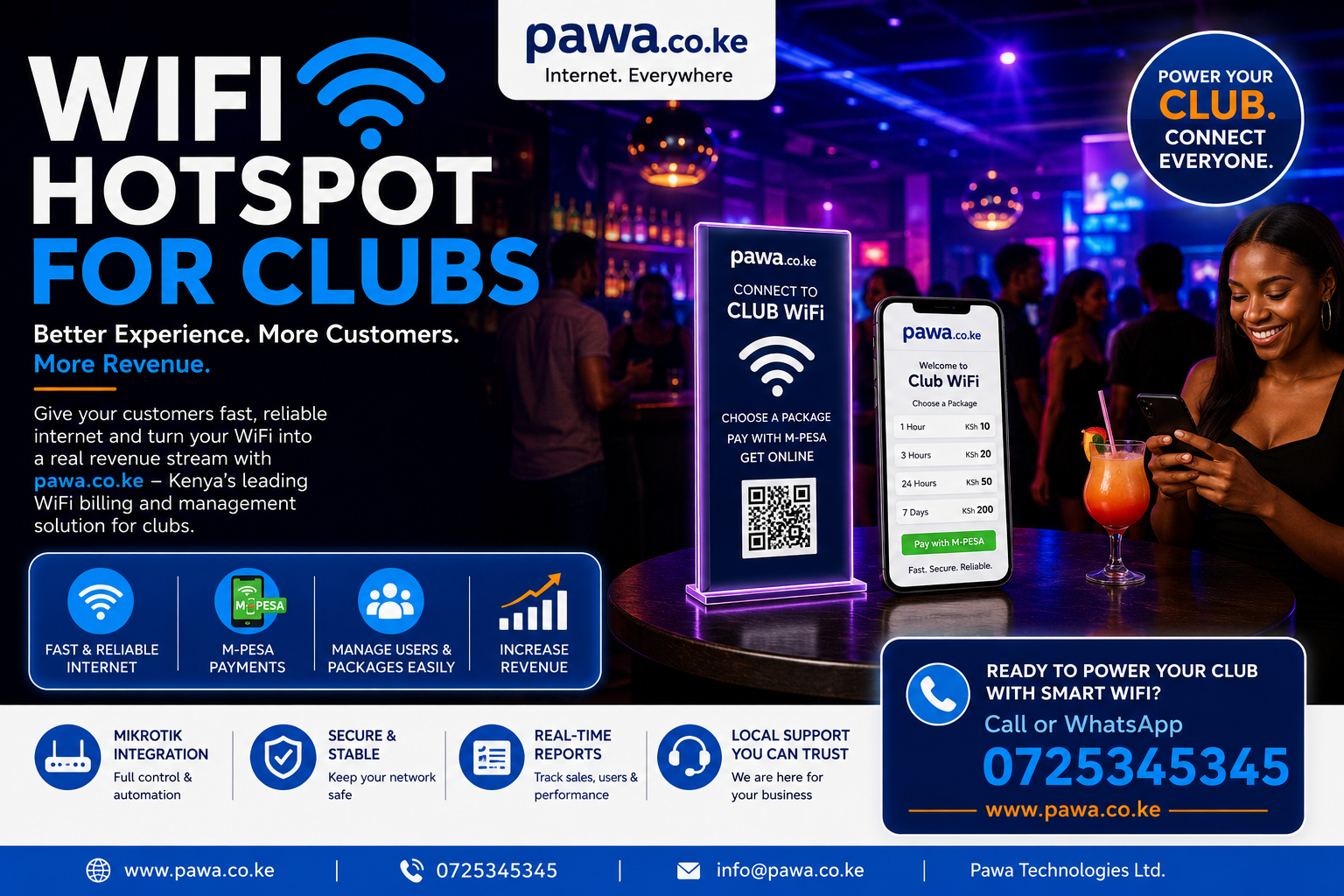
With Pawa’s MikroTik-oriented setup, customers can select packages, pay through M-Pesa and have access activated automatically. Pawa describes its hotspot workflow as connecting customer package selection, M-Pesa payment and MikroTik access.
This makes the wifi hotspot for clubs more than a simple wireless network. It becomes a managed connectivity system.
Wifi hotspot for clubs: The free WiFi revenue model
A wifi hotspot for clubs can also generate indirect financial value even when customers do not pay for internet access.
Free WiFi can increase customer satisfaction.
Customers may stay longer.
Members may visit more frequently.
Customers may share content from the venue.
The club can use the captive portal to display promotions, events or membership information.
The club can potentially use WiFi analytics to understand general network demand, subject to appropriate privacy practices and applicable requirements.
In this model, the internet connection becomes a customer-experience investment rather than a direct revenue product.
The financial calculation is therefore different.
If providing WiFi costs an additional KES 5,000 per month but contributes to additional customer spending that exceeds that amount, the WiFi can still make commercial sense.
Wifi hotspot for clubs: Premium access model
A wifi hotspot for clubs can provide customers with different levels of connectivity.
For example, basic users could receive a lower-speed package while premium customers receive higher speeds.
This can work particularly well when customers have different requirements.
A casual customer may only need messaging and social media.
Another customer may want to stream video.
A business customer may want to use a laptop for work.
Instead of giving every user the maximum available speed, the club can create differentiated packages.
Pawa supports configurable WiFi packages and MikroTik profiles, allowing operators to manage different access plans.
Wifi hotspot for clubs: Choosing the right internet connection
The internet source is one of the most important components of a wifi hotspot for clubs.
A club should evaluate available fibre, fixed wireless, satellite or other legitimate connectivity options.
The decision should be based on expected traffic, reliability, installation availability, cost and the intended use.
A club serving 20 simultaneous customers has different requirements from a club serving 300 simultaneous users.
The operator should estimate the number of connected devices rather than simply counting people.
If 100 customers each have two devices, the network may need to handle around 200 customer devices.
Staff devices and operational equipment must be added to that number.
The upstream internet connection should therefore be selected after estimating actual usage.
Wifi hotspot for clubs: Why bandwidth matters
Bandwidth is one of the most important factors in a wifi hotspot for clubs.
If the available bandwidth is too low, customers may experience slow browsing, buffering and disconnections.
However, purchasing more bandwidth is not always the first solution.
The club should first determine what is consuming the existing connection.
If a few devices are downloading large files, bandwidth controls can improve the experience for everyone.
If the access points are overloaded, additional wireless infrastructure may be required.
If the upstream connection itself is insufficient, upgrading the internet plan may be necessary.
A professional network therefore combines bandwidth capacity with traffic management.
Wifi hotspot for clubs: Bandwidth management
A wifi hotspot for clubs should ideally prevent a small number of users from consuming all available resources.
Bandwidth management can establish reasonable limits.
For example, a club could allocate a lower speed to standard guest access and higher speeds to premium packages.
The exact limits depend on the internet connection and number of users.
MikroTik networking equipment can be used for controlled access and bandwidth management, and Pawa’s current hotspot system is designed around MikroTik RouterOS.
The goal is not to make the network unnecessarily restrictive.
The goal is to make the available capacity predictable.
Wifi hotspot for clubs: Network equipment required
A wifi hotspot for clubs normally requires several network components.
The first is the internet connection.
The second is a MikroTik router or suitable gateway for controlled hotspot billing where Pawa is being used.
The third is wireless access points.
The fourth is network switches where multiple access points or wired devices are required.
The fifth is Ethernet cabling.
The sixth is appropriate power equipment.
The seventh is billing and authentication software.
Pawa specifically states that its automated hotspot and PPPoE access control requires a MikroTik gateway or controller. A normal home router can feed internet into the network or operate as an access point, but it does not provide the complete Pawa billing gateway functionality.
Wifi hotspot for clubs: Why MikroTik matters
MikroTik is particularly useful for a managed wifi hotspot for clubs because the router can act as the control point between the internet connection and customers.
Pawa integrates with MikroTik RouterOS to manage hotspot access.
This allows the system to connect customer billing with network access.
For example, when a customer pays for a package, the billing system can communicate with the MikroTik environment and activate access.
When the package expires, access can be suspended.
Pawa’s current MikroTik hotspot solution supports daily, hourly, weekly and monthly packages, captive portal login, M-Pesa billing, voucher tracking and router management.
This is considerably more structured than using a shared WiFi password.
Wifi hotspot for clubs: Access points and coverage
A wifi hotspot for clubs should not rely on one router simply because the venue has a strong internet connection.
Wireless coverage depends on physical conditions.
Walls, ceilings, furniture, equipment, distance and interference can affect the signal.
A large club may require multiple access points.
The access points should be positioned according to the venue’s physical layout and expected customer density.
For example, the dance floor may have many people but relatively short internet sessions, while a lounge area may have fewer customers who spend more time connected.
The network design should account for these differences.
Wifi hotspot for clubs: Separating customers and staff
A professional wifi hotspot for clubs should consider network segmentation.
Guest WiFi should not automatically have unrestricted access to staff systems.
A club may have POS systems, computers, printers, cameras and administrative devices that require stronger protection.
Guest devices should therefore be separated from sensitive business equipment.
A common structure could include a guest network, staff network and management network.
This arrangement can reduce the risk that a compromised guest device affects critical business infrastructure.
Wifi hotspot for clubs: Protecting POS systems
A wifi hotspot for clubs must not compromise the security of payment systems.
Point-of-sale terminals, payment devices and business computers should be protected from unrestricted guest traffic.
The club should avoid placing all devices on one flat network.
Network segmentation can reduce unnecessary exposure.
The club’s IT provider or network technician should configure access rules according to the actual infrastructure.
This is particularly important for clubs that process many transactions every day.
Wifi hotspot for clubs: M-Pesa payment integration
A wifi hotspot for clubs can use M-Pesa as a convenient payment mechanism for paid internet.
Pawa’s M-Pesa billing platform supports STK Push workflows and can connect payment records to customer access.
A typical customer journey can be:
Connect to WiFi.
Select package.
Enter or confirm payment details.
Receive M-Pesa prompt.
Approve payment.
Payment is confirmed.
Internet access is activated.
This process reduces the need for staff to collect cash or manually activate accounts.
Wifi hotspot for clubs: Why automated payments are better
A wifi hotspot for clubs can receive many payment requests during peak periods.
Imagine a busy Friday evening when 100 customers want internet access.
If staff must manually check M-Pesa messages, record each payment and create every account, queues can develop.
Automation removes much of this repetitive work.
Pawa’s platform is specifically designed to connect M-Pesa payment workflows with hotspot access. It handles payment initiation, callbacks, status tracking and payment-to-access records.
This makes the customer journey faster and reduces administrative work.
Wifi hotspot for clubs: Creating WiFi packages
A wifi hotspot for clubs can use several package types.
Hourly packages are suitable for short visits.
Daily packages are useful for customers who stay for several hours.
Weekly packages may suit frequent visitors.
Monthly packages can work for staff or members.
Pawa supports daily, hourly, weekly and monthly hotspot packages.
The club should not create too many packages at launch.
Three to five clearly defined options are usually easier for customers to understand than a long list.
The club can then review sales and adjust the package structure.
Wifi hotspot for clubs: Example pricing strategy
A wifi hotspot for clubs could test an illustrative pricing structure such as:
KES 10 for a short session.
KES 20 for several hours.
KES 50 for a full day.
KES 200 for a longer package.
These numbers are examples rather than universal recommended prices.
The club should determine pricing according to its customer profile and competition.
A premium members’ club may be able to charge more for premium service.
A casual entertainment venue may need lower pricing.
The most important measurement is not the price itself but the relationship between price, demand and operating costs.
Wifi hotspot for clubs: Calculating potential daily revenue
A wifi hotspot for clubs can estimate revenue using customer volume and average transaction value.
Suppose 60 customers purchase WiFi during an evening.
If the average transaction is KES 20, daily sales are KES 1,200.
If the club operates 26 comparable days per month, monthly sales would be approximately KES 31,200.
Suppose WiFi-specific operating costs are KES 18,000 per month.
The remaining amount would be KES 13,200 before other costs and equipment depreciation.
This simple model gives the club a starting point for determining whether paid WiFi is commercially worthwhile.
Wifi hotspot for clubs: Calculating a premium package
A wifi hotspot for clubs can increase average transaction value through premium packages.
Suppose 40 customers buy a KES 20 standard package and 20 customers buy a KES 40 premium package.
Standard sales equal KES 800.
Premium sales equal KES 800.
Total sales equal KES 1,600.
The club therefore earns KES 400 more than if all 60 customers had purchased the KES 20 package.
Premium pricing only works if the additional service provides sufficient value.
Wifi hotspot for clubs: Free and premium hybrid strategy
A wifi hotspot for clubs can combine complimentary access with premium packages.
For example, the club might provide basic browsing at a limited speed while charging for higher-speed access.
This creates a customer-friendly entry point.
Customers who only need messaging can use the basic service.
Customers who want stronger connectivity can upgrade.
This model can also reduce pressure on the network because premium users can receive dedicated bandwidth profiles.
Wifi hotspot for clubs: Membership-based WiFi
A wifi hotspot for clubs can be connected to membership.
Members could receive complimentary internet as part of their membership.
Non-members could purchase packages.
Premium members could receive higher speeds.
This creates a differentiated customer experience.
It can also make membership more attractive.
The club should calculate whether the additional internet cost is justified by increased membership revenue.
Wifi hotspot for clubs: WiFi for sports clubs
A wifi hotspot for clubs is particularly useful for sports clubs.
Members may use WiFi to follow live scores, communicate with teams, access training resources, stream content and share match-day experiences.
The club can create designated WiFi areas around spectator zones, lounges and meeting areas.
A sports club may also use the network for staff and administrative operations.
Network segmentation becomes important because customer traffic and business systems should not necessarily share unrestricted access.
Wifi hotspot for clubs: WiFi for nightclubs
A wifi hotspot for clubs can also be valuable in nightlife venues.
Customers frequently use smartphones to take photos and videos, communicate with friends and share experiences on social media.
A reliable connection can therefore support the venue’s marketing indirectly.
The nightclub can also use the captive portal to promote upcoming events, VIP nights, offers or membership programs.
However, nightlife venues can experience highly concentrated demand.
The network should therefore be designed for peak traffic rather than average traffic.
Wifi hotspot for clubs: WiFi for lounges
A wifi hotspot for clubs can become a major customer amenity in lounges.
Customers who spend one or two hours at a lounge may expect reliable internet.
Business professionals may use the space for meetings.
Customers may make calls, access social media or stream content.
The lounge can provide free access or create premium packages.
If the service is paid, the purchase process should be quick.
Customers should not need to wait for an employee to activate their account.
Wifi hotspot for clubs: WiFi for members’ clubs
A wifi hotspot for clubs can be incorporated into a members’ club as part of the overall membership experience.
Members could receive automatic access based on their membership status.
The club can maintain separate policies for visitors.
For example, a member may receive unrestricted access while a guest receives a limited package.
This approach can make the WiFi system part of the club’s customer-management strategy.
Wifi hotspot for clubs: WiFi for private events
A wifi hotspot for clubs can also support temporary events.
Weddings, corporate events, launches, parties and conferences may require temporary internet.
Pawa’s current M-Pesa WiFi billing material specifically lists temporary events among potential use cases for its hotspot billing workflow.
The club can create event-specific packages or provide complimentary event access.
A temporary network should be planned according to expected attendance and usage.
Wifi hotspot for clubs: Testing before launch
A wifi hotspot for clubs should be tested before customers are invited to use it.
Test the internet connection.
Test every access point.
Test customer authentication.
Test package activation.
Test M-Pesa payments.
Test expiry.
Test reconnecting after payment.
Test staff networks.
Test guest isolation.
Test peak-load assumptions where possible.
A launch-day technical failure can create a poor first impression.
Wifi hotspot for clubs: Pawa onboarding requirements
A wifi hotspot for clubs using Pawa should be built around a compatible MikroTik setup.
Pawa’s current setup guidance states that the billing control should pass through MikroTik and that the platform needs a MikroTik gateway or controller for automated Hotspot or PPPoE access control.
The operator should therefore establish the router model, internet source, access-point configuration, packages and M-Pesa details before implementation.
Pawa’s MikroTik setup page also identifies package prices and durations, M-Pesa business details and preferred contact information as relevant onboarding information.
Wifi hotspot for clubs: Pawa billing management
A wifi hotspot for clubs can use Pawa to connect billing and network access.
Pawa’s platform is designed for Kenyan hotspot operators and supports M-Pesa payments, customer packages, vouchers, routers and access management.
The system is particularly useful when a club wants to move away from manual WiFi management.
Instead of staff repeatedly changing passwords, the platform can automate customer access according to package and payment status.
This gives the club more control over the service.
Wifi hotspot for clubs: Using the captive portal for promotions
A wifi hotspot for clubs can turn its captive portal into a small marketing channel.
Customers who connect can see:
Upcoming events.
Membership promotions.
Food offers.
VIP packages.
Club announcements.
Sponsor promotions.
The portal should remain useful and not become overloaded.
A fast connection experience should remain the priority.
Wifi hotspot for clubs: Sponsorship opportunities
A wifi hotspot for clubs may also provide opportunities for sponsorship.
A telecom company, beverage brand, event organizer or local business could sponsor guest WiFi.
For example, the portal might display a sponsor message before access.
The club could potentially offset part of its WiFi operating costs through sponsorship.
Any commercial arrangement should comply with the relevant terms and advertising requirements.
Wifi hotspot for clubs: WiFi as a customer experience tool
A wifi hotspot for clubs can strengthen the overall customer experience.
Customers can stay connected while enjoying the venue.
They can communicate with friends.
They can share content.
They can access online services.
They can make digital payments.
They can search for information.
The club becomes more convenient.
This is especially relevant for customers who spend several hours at the venue.
Wifi hotspot for clubs: WiFi and social media marketing
A wifi hotspot for clubs can indirectly support social-media marketing.
Customers may upload videos and photos from the venue.
They may tag the club.
They may share events.
They may post reviews.
Reliable connectivity makes this easier.
The club should not assume that WiFi automatically creates social-media exposure, but it removes one potential barrier.
Wifi hotspot for clubs: WiFi and customer retention
A wifi hotspot for clubs can contribute to customer retention.
Customers may appreciate venues where connectivity works consistently.
If two comparable clubs offer similar entertainment, food and pricing, reliable WiFi can become one of the smaller factors influencing customer preference.
The club should therefore view WiFi as part of its service quality.
Wifi hotspot for clubs: Staff WiFi management
A wifi hotspot for clubs should provide separate access for employees.
Staff may require internet for POS systems, communication, inventory, management and operational applications.
Staff traffic should not compete unnecessarily with customer traffic.
Separate network policies can help ensure that critical business devices maintain reliable access.
Wifi hotspot for clubs: Club management systems and WiFi
A wifi hotspot for clubs can exist alongside other digital business systems.
A club may use POS software, payroll software, accounting systems, property systems or customer-management tools.
The WiFi network should be designed to support these services without exposing them unnecessarily to guests.
For businesses operating multiple venues, digital management platforms can also become important.
Wifi hotspot for clubs: Relevant digital business resources
A wifi hotspot for clubs can be one component of a broader digital transformation strategy.
Businesses that operate physical venues may also require POS, property, HR, accounting or customer-management tools.
For example, businesses exploring other Kenyan digital platforms can review resources such as:
These resources can be used naturally as supporting references rather than replacing the dedicated WiFi billing function provided by Pawa.
Wifi hotspot for clubs: Monthly financial review
A wifi hotspot for clubs should calculate monthly performance.
Record total WiFi sales.
Subtract internet costs.
Subtract software costs.
Subtract electricity.
Subtract maintenance.
Subtract payment-related costs.
Subtract revenue sharing if applicable.
Calculate the remaining contribution.
Then compare it with the previous month.
If sales increased but profit decreased, investigate why.
The problem may be higher bandwidth costs, excessive discounts or other expenses.
Wifi hotspot for clubs: WiFi and customer satisfaction
A wifi hotspot for clubs should ultimately serve the customer.
Customers do not care about router specifications.
They care whether the internet works.
The best WiFi system is therefore one that customers barely notice because it works consistently.
Reliability, easy access and predictable performance are more valuable than unnecessary technical complexity.
Wifi hotspot for clubs: Is paid WiFi better than free WiFi?
A wifi hotspot for clubs can use either model.
Free WiFi can improve customer experience.
Paid WiFi can create direct revenue.
Hybrid WiFi can combine both.
There is no universal answer.
The club should consider its customer expectations and financial objectives.
A premium members’ club may find free WiFi more appropriate.
A commercial hotspot business may prefer paid access.
A nightclub may use a hybrid model.
Wifi hotspot for clubs: How Pawa fits into the business model
A wifi hotspot for clubs can use Pawa as the operational billing layer.
The club provides the physical venue and internet connection.
MikroTik controls network access.
Access points distribute the WiFi.
Pawa manages packages, payment workflows, customer access and router-related operations.
Customers connect and pay.
The system activates access.
This creates a structured process from customer purchase to internet access.
Pawa’s homepage describes this flow as customer package selection, M-Pesa payment, payment confirmation and MikroTik activation.
Wifi hotspot for clubs: Getting started with Pawa
A wifi hotspot for clubs can begin by defining its requirements.
Identify the number of expected customers.
Identify the venue size.
Identify the internet source.
Determine whether the club already has a MikroTik router.
Determine the number of access points required.
Define packages.
Choose the payment approach.
Configure the captive portal.
Test the system.
Launch.
Pawa provides onboarding guidance for operators starting a hotspot or PPPoE business.
Wifi hotspot for clubs: Frequently asked questions
Wifi hotspot for clubs: Can a nightclub offer paid WiFi?
Yes. A nightclub can offer paid WiFi through packages that customers purchase through a captive portal. The club can use hourly, daily or other packages depending on its business model. Pawa supports paid hotspot packages and M-Pesa-based access workflows.
Wifi hotspot for clubs: Can a sports club offer free WiFi?
Yes. A sports club can provide complimentary WiFi as a member benefit. The club can also create premium access for customers who need higher speeds or longer sessions.
Wifi hotspot for clubs: Do I need MikroTik?
If the club intends to use Pawa’s automated Hotspot or PPPoE billing workflow, Pawa states that a MikroTik gateway or controller is required. A normal home router can feed internet into the network or work as an access point but is not the billing gateway for the full automated flow.
Wifi hotspot for clubs: Can customers pay with M-Pesa?
Yes. Pawa’s current WiFi billing platform supports M-Pesa STK, PayBill and Till workflows, depending on the operator’s chosen collection setup.
Wifi hotspot for clubs: Can I manage multiple branches?
Yes. Pawa supports multiple routers and business workspaces, with its larger plans designed for growing hotspot and ISP-style operations.
Wifi hotspot for clubs: How much does Pawa cost?
Pawa currently lists Starter at KES 1,500/month and Silver at KES 3,500/month. Pawa collection adds 5% of net WiFi sales, while using your own PayBill/Till avoids that 5% collection fee. Hardware, access points, cabling, installation and internet costs are separate.
Wifi hotspot for clubs: Can I use vouchers?
Yes. Pawa supports voucher-based hotspot access alongside M-Pesa-based customer purchases. Its voucher system is designed for short sessions, daily access, weekly access and other package types.
Wifi hotspot for clubs: How many access points do I need?
There is no universal number. The requirement depends on venue size, walls, customer density, interference and expected simultaneous users. A site survey is the best way to determine the appropriate number.
Wifi hotspot for clubs: Can WiFi become a separate revenue stream?
Yes, if customers are willing to pay for access and the resulting revenue exceeds the additional operating costs. The club should calculate revenue using actual customer volume and average transaction value instead of relying on generic profit claims.
Wifi hotspot for clubs: Is Pawa suitable for a small club?
Pawa currently lists its Starter plan for small hotspots and cafés, with support for up to two MikroTik routers and up to 2,000 users. Whether it is appropriate for a particular club depends on its actual deployment and requirements.
Wifi hotspot for clubs takeaway
A wifi hotspot for clubs can be positioned as both a customer-experience solution and a potential connectivity business opportunity. The most important elements are reliable internet, properly positioned access points, a MikroTik-controlled network, secure customer access, bandwidth management, simple packages and automated payment processing.
For clubs in Kenya, M-Pesa is particularly useful because it allows customers to pay for connectivity without requiring a cash transaction at the reception desk. Pawa connects this payment workflow with hotspot access and MikroTik management, allowing operators to move from payment to internet activation with less manual intervention.
The business should then be managed using actual numbers. If a club generates KES 30,000 in WiFi sales but spends KES 25,000 operating the service, the contribution is only KES 5,000. If another club generates KES 60,000 while spending KES 25,000, the economics are very different.
That is why every wifi hotspot for clubs should be evaluated based on customer volume, package prices, average transaction value, internet costs, software costs, electricity, maintenance, equipment investment and downtime.
For clubs ready to automate their WiFi billing and customer access, Pawa provides a Kenya-focused solution built around MikroTik, M-Pesa, hotspot packages, vouchers, customer management and revenue visibility.